When Nitsa Tokatlidis felt a sharp pain in her lower back while opening a window, she couldn’t have imagined something so simple could change so much.
The secondary school educator was used to the occasional niggle, but this was different. Within hours, she felt numbness down her leg, severe stiffness and pain that affected her sleep.
‘I didn’t realise how bad it was,’ she says. ‘I was waking up during the night, which is not something I’m used to. I normally sleep through.’
Nitsa consulted with Osteopath Leesa Mackay, who suggested she transition into the getback exercise therapy program.
Despite her trust in Leesa, she was uncertain at first.
‘I was a bit dubious about doing exercise physiology,’ Nitsa admits. ‘I wasn’t sure whether it could help me.’
At school, she kept teaching—pushing through the discomfort and determined not to let her students down. But lifting even modest weight and the long walks she loved along bayside beaches triggered pain in her lower back.
A turning point in treatment
With symptoms persisting, Nitsa decided to complete an assessment for the getback exercise therapy program.
Her initial scepticism turned to relief once she began working with Exercise Physiologist Sean Ahearn, who guided her personalised exercise therapy program using the getback spinal devices.
Sean, she says, made all the difference.
‘He assisted me with all the exercise devices and used his expertise to release my energy, my mobility and strength. He was outstanding.’
Progress measured, and felt
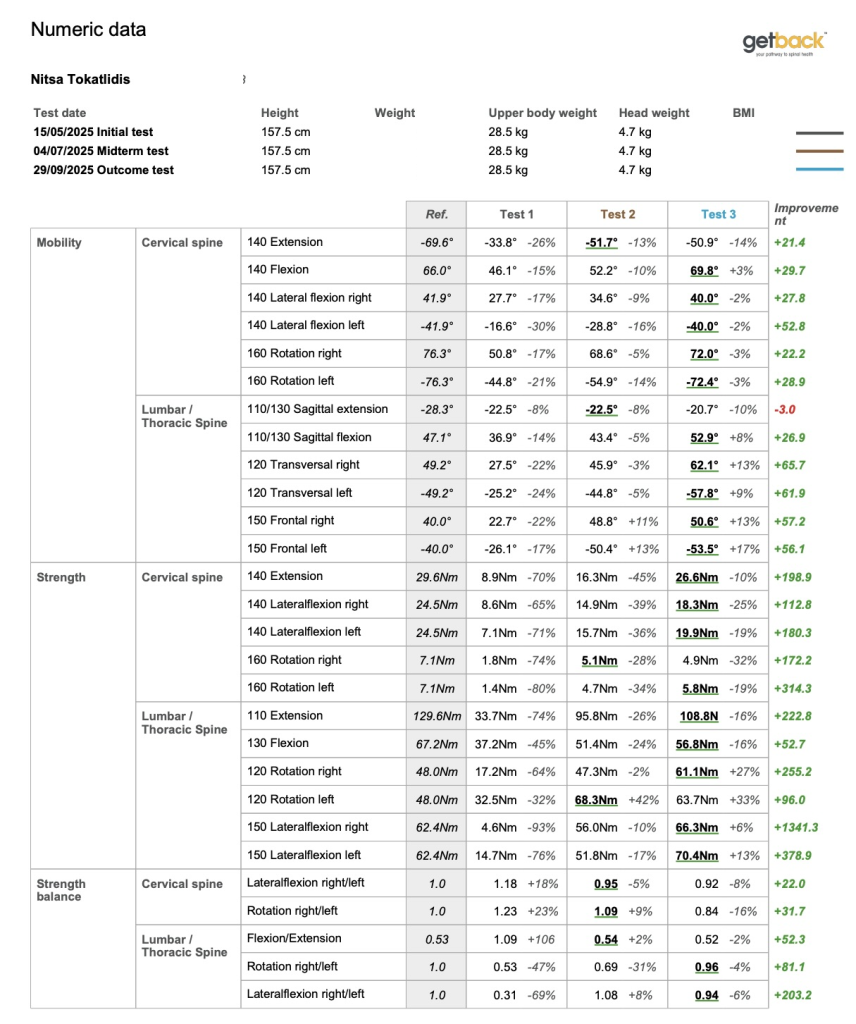
Nitsa’s initial assessment precisely measured the strength, range of movement and imbalances of her spinal muscles. The results made it clear how much support her body needed.
‘There wasn’t much I could do at the start,’ she says. ‘It was evident in the data mapping. I didn’t realise how bad I was.’
Nitsa’s exercise therapy program started very gradually and safely. Exercises on the getback spinal devices were controlled, supported and tailored to her limitations.

After about 10 sessions, she noticed real improvement. Mobility returned. Pain reduced. Strength began to rebuild. Then came a six-week break for a long-planned trip to Europe.
Back home, she finished the program feeling markedly different.
Measurable change—and real relief
The comparison between her initial assessment and her final results was striking.
‘There were huge improvements in my mobility and strength,’ Nitsa says. ‘It was amazing to see it in the data.’
More importantly, she could feel the difference. The leg numbness disappeared. The stiffness eased. Pain levels dropped significantly.
‘I still get some pain if I walk long distances, but I try to do 10,000 steps a day now. I’m definitely much better,’ she says.
Impressively, Nitsa managed to keep teaching throughout.
‘You always want to do the right thing,’ she says. ‘As long as I was receiving treatment that I knew was helping me, I was okay to keep going.’
The power of support and structure
For Nitsa, the data-driven framework of getback was more than reassurance — it was motivation.
‘Seeing the improvements before and after was huge,’ she says.
But when she’s asked what stood out most about the program, she doesn’t hesitate.
‘Sean was outstanding. A true professional.’
Exercise Physiologist Sean Ahearn points to Nitsa’s motivation and commitment to her program as an important factor in her progress.
‘The mid-program assessment becomes a real moment of recognition for most people, and Nitsa was no different,’ he said.
‘Seeing the contrast between where she began, and where she was mid-way, reinforced that the work she was putting in was creating meaningful change.’
He said that Nitsa’s final results (below) highlighted the real world functional gains she had made.
‘When Nitsa first came to see me, she said she felt “trapped in her own body”, and even simple movements were a challenge.’
‘So by the end of the program, to hear her talk about climbing ladders and doing maintenance around the property was a real testament to her progress.’